
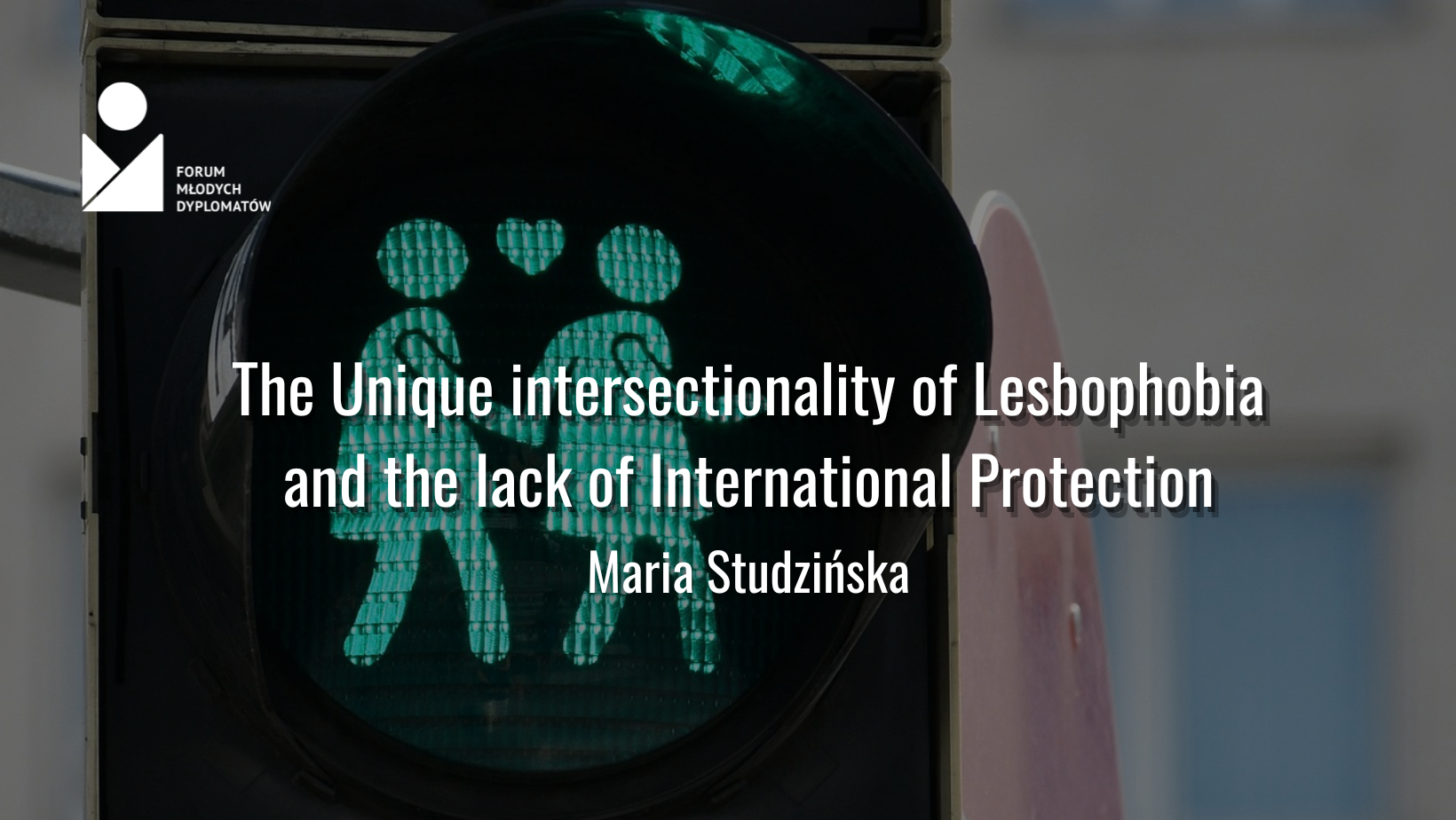
As we approach the International Women’s Day, we focus on the challenges and overcoming thereof by women. Rich history of feminist movement, dating back as far as to the 1800s, consequently paints the image of the devoted to “freeing themselves” of oppression, and hero-like women. With the introduction of the fight for LGBTQ rights, alongside the perpetual process of ridding women of their patriarchal oppression, we come across the fundamental problem of this article – is violence against lesbians (and other women loving women persons) a violation of women’s rights or gay rights?
The answer to our query is simple and complicated at the same time. Kimberlee Crenshaw comes to our aid with “intersectionality”, a term she coined in 1989 in her article “Demarginalizing the Intersection of Race and Sex: A Black Feminist Critique of Antidiscrimination Doctrine, Feminist Theory and Antiracist Politics”. Intersectionality describes the phenomena of two or more characteristic that constitute to one’s oppression coexist and intertwine, consequently making a completely new and unique form of discrimination. Crenshaw’s article originally concentrates on the intermingling of black women’s problems and the uniqueness of their discrimination, which is important to highlight to not lose the importance of the original article. But the framework produced by Crenshaw can and is used to interpret other planes of oppression that coexist.
This article will engage in the intersectionality of lesbophobia, consequently answering the question – women’s rights violations and gay right’s violations intermingle to create the uniqueness of lesbophobia.
Author: Maria Studzińska
Convention on the Elimination of All Forms of Discrimination against Women and the Istanbul Convention are essential milestones accomplished by the international community to protect the rights of women and to combat woman-focused violence. They are the backbone of international efforts to fight discrimination against women. The United Nations convention was established in 1979 and highlights a key definition of this specific discrimination. First Article of the Convention define “discrimination against women” as any exclusion made on the basis of sex that constrict women, no matter their marital status. It focuses more on the equality of men and women, without mentioning either race or sexual orientation.
The Convention was and still is rather monumental in the history of protection of women’s rights, but due to its age, it can seem slightly outdated. This was a predicted phenomenon, as the Article 17 of the Convention establishes a Committee on the Elimination of Discrimination against Women. The Committee issues recommendations and suggestions to the General Assembly of the United Nations to ensure the applicability of the Convention in the ever progressing world. In General recommendation No. 28 on the core obligations of States parties under article 2 of the Convention on the Elimination of All Forms of Discrimination against Women of 2010 the Committee recognizes the intersectionality of discrimination of women based on sex, gender and other vulnerabilities such as race or sexual orientation, urging states to legally recognize such intersection of discrimination and its impact on women. The recommendations, although important interpretations of quality data, are not strictly biding like the Convention or other international laws, leaving lesbians vulnerable to the actions or inactions of the states in which they live.
The Istanbul Convention challenges the topic by encompassing sexual orientation (among other things like race) in its official text, thus it does not have to rely on soft unbinding recommendations to protect women who also happen to be gay. As stated in Article 4 of the IC “The implementation of the provisions of this Convention by the Parties,(…) shall be secured without discrimination on any ground such as sex, gender, race(…), sexual orientation (…)”. The specific wording and inclusion of sexual orientation as one of the grounds for discrimination against women to be prohibited is a significant milestone. The IC forces the Parties to develop legal frameworks to prohibit or punish the instances of several discriminations and violence against women, for example stalking, sexual violence, physical violence, forced marriage, forced sterilization, domestic violence etc. What the Convention fails to address is the uniqueness of lesbophobia and other discriminatory actions against women loving women as consequence of the intersectionality of womanhood and queerness. The main body of the Convention focuses on the general female-targeted violence and discrimination.
The real violence is more complicated than that described in the Conventions mentioned before. Lesbians fall victim to patriarchy in a very specific way, as they are systematically oppressed by the sexist and heteronormative systems put in place by the society as a whole. According to the EuroCentraAsian Lesbian Community, lesbophobia is a unique form of bias that incorporate misogyny, sexism and stigmatization around non-conforming sexual orientation. Prejudice is fueled by the few things, namely the rebellion against societal expectation and stereotypes of the gender binary by simply existing, the refusal to be at the men’s disposal and the challenge lesbians sexuality poses to the image of female sexuality. Lesbians pose a threat to at least two prior existing status quo of our society, making them not only a target because of men’s will, but also because of their fear. Crimes committed against lesbians impact both women and gay people, already vulnerable in patriarchal society. In contrast with gay men, lesbians or bisexual women experience harassment in relation to their gender almost 15 times more often than gay (29% lesbians, 46% bisexual women, 2% gay men declared their gender as additional motive for their harassment).
Corrective rape is a form of rape with the motive and intention for lesbians to be “cured” of their queerness by the hand of straight men. It was originally coined after the brutal gang rape and murder of Eudy Simelane, a South African football player. The motive of the corrective rape is usually well known by the verbal abuse during the act. Lesbians are the community that is affected by corrective rape the most, with the intention to either punish or correct the nonconforming to the patriarchal status quo behaviors of lesbians. As said by Sarah Doan-Minh, “corrective rape is a punishment for the gay woman’s perceived violation of both heteronormative masculinity and femininity in an institutionally heterosexual society”. Istanbul Convention fails to recognize the uniqueness of the motive behind this horrendous act of sexual violence in Article 36 and simply generalizes it along other criminal or offensive acts listed in Chapter V. Consequently it creates an environment for the legal system to fail to appropriately address the unique issues of corrective rape on lesbians and misses the potential to develop prevention strategies.
Similarly, when examining another article of the Convention, Article 37, we may conclude that forced marriage is prohibited in any and all instances. However this omits the motive behind forced marriages for gay women, which are a way for the families of these women to “correct” the lesbian behavior or enforce the conformist idea of the heterosexual relationship between a man and a woman. Forced heterosexual marariage is a form of domestic abuse perpetuated by the closest family of the victim, with the intent to make her act and be “normal”. The generalization of violence against lesbians under the umbrella term of women’s rights done by the IC proves Kimberle Crenshaws point – being at the intersection makes you vulnerable to fall through the cracks and become legally invisible. Lesbians are protected as any other woman is, but they are in need of protection specific to their kind of homophobia-and-misogyny-driven abuse.
Violence against lesbians isn’t solely an issue of either women’s rights or gay rights; rather, it is a unique and compounded form of oppression situated at the intersection of both, making lesbians particularly vulnerable. The Convention on the Elimination of All Forms of Discrimination against Women and Istanbul Convention give crucial groundwork for the efforts of fighting discrimination and violence against women by their clauses about non-discrimination, but the generalized language and the lack of recognition of the uniqueness of lesbophobia fails to prosecute this violence and protect gay women. In the upcoming celebrations of International Women’s Day, this article urges for a moment of reflection about this issue, as we as a society should be better prepared to truly protect all women. Establishing sexual orientation as a non-discriminatory trait is a first step, the next is to recognize and dismantle the unique, intersectional motives behind lesbophobic violence.
Bibliography:
[1] Committee on the Elimination of Discrimination against Women (CEDAW). General Recommendation No. 28 on the Core Obligations of States Parties under Article 2 of the Convention on the Elimination of All Forms of Discrimination against Women. UN Doc. CEDAW/C/GC/28. December 16, 2010.
[2] Council of Europe. Council of Europe Convention on Preventing and Combating Violence against Women and Domestic Violence. Council of Europe Treaty Series no. 210. Istanbul, May 11, 2011.
[3] Crenshaw, Kimberle. “Mapping the Margins: Intersectionality, Identity Politics, and Violence against Women of Color.” Stanford Law Review 43, no. 6 (July 1991): 1241–99.
[4] Doan-Minh, Sarah. “Corrective Rape: An Extreme Manifestation of Discrimination and the State’s Complicity in Sexual Violence.” Hastings Women’s Law Journal 30, no. 1 (2019): 167–200.
[5] European Lesbian* Conference (ELC). Lesbophobia: An Intersectional Form of Violence. Brussels: European Lesbian* Conference, 2019.
[6] UN General Assembly. Convention on the Elimination of All Forms of Discrimination against Women. United Nations Treaty Series, vol. 1249. December 18, 1979.